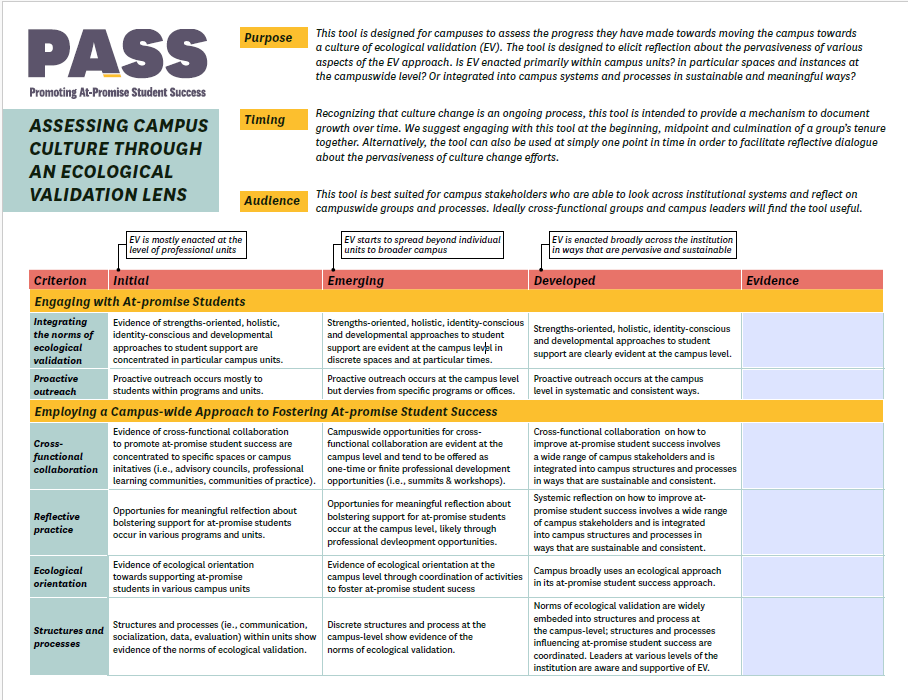
This tool provides a framework for assessing the integration of ecological validation (EV) into campus cultures to support at-promise students. It offers tools and metrics for evaluating progress in areas such as outreach, cross-functional collaboration, leadership engagement, data use, and reflective practices, emphasizing the importance of sustainable, systemic change at institutional levels.
Archives: Articles/Briefs
Developing a summit or professional development event.
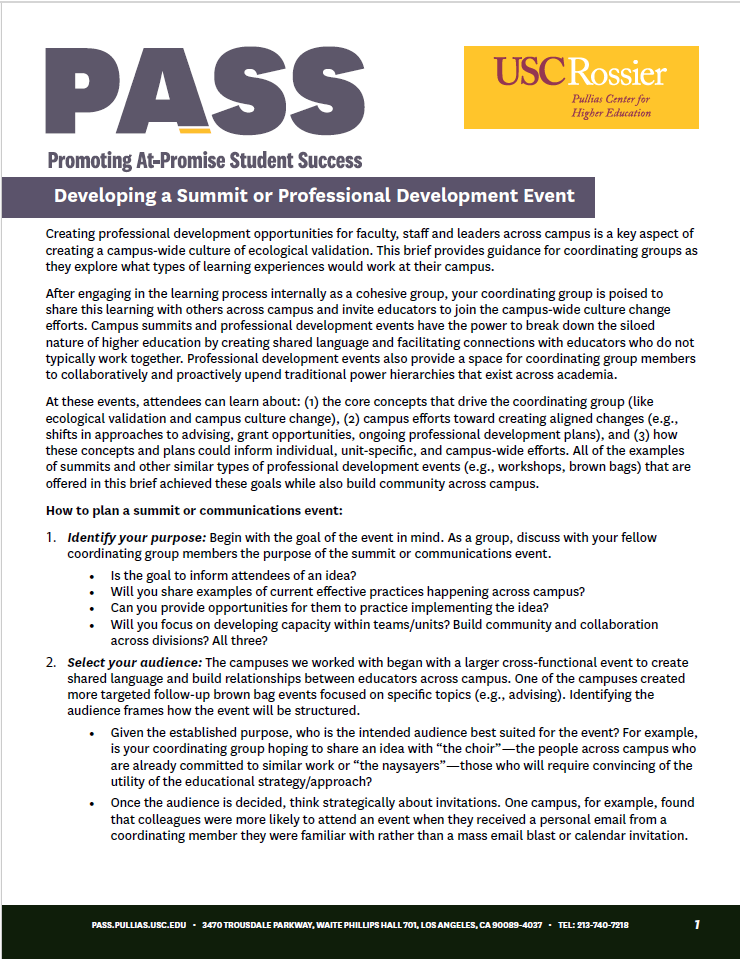
This activity brief offers a guide for planning summits or professional development events focused on promoting ecological validation and systemic cultural change in higher education. It includes strategies for defining event goals, engaging cross-functional participants, fostering collaboration, and utilizing data to measure impact and inform future efforts.
Creating a constellation of student support using ecological validation.
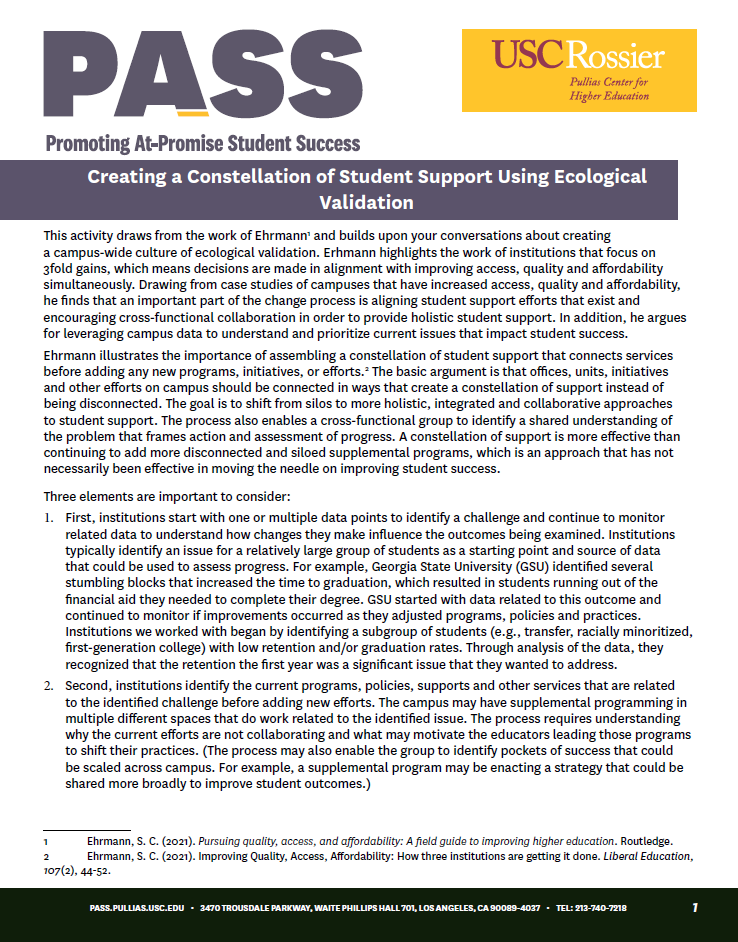
This activity brief outlines a step-by-step process for creating a “constellation of student support” using ecological validation principles to address systemic challenges in higher education. It emphasizes cross-functional collaboration, leveraging existing resources, and centering student success through proactive, holistic, and identity-conscious approaches.
Ecological validation coordinating groups: Key processes related to campus-wide culture change.
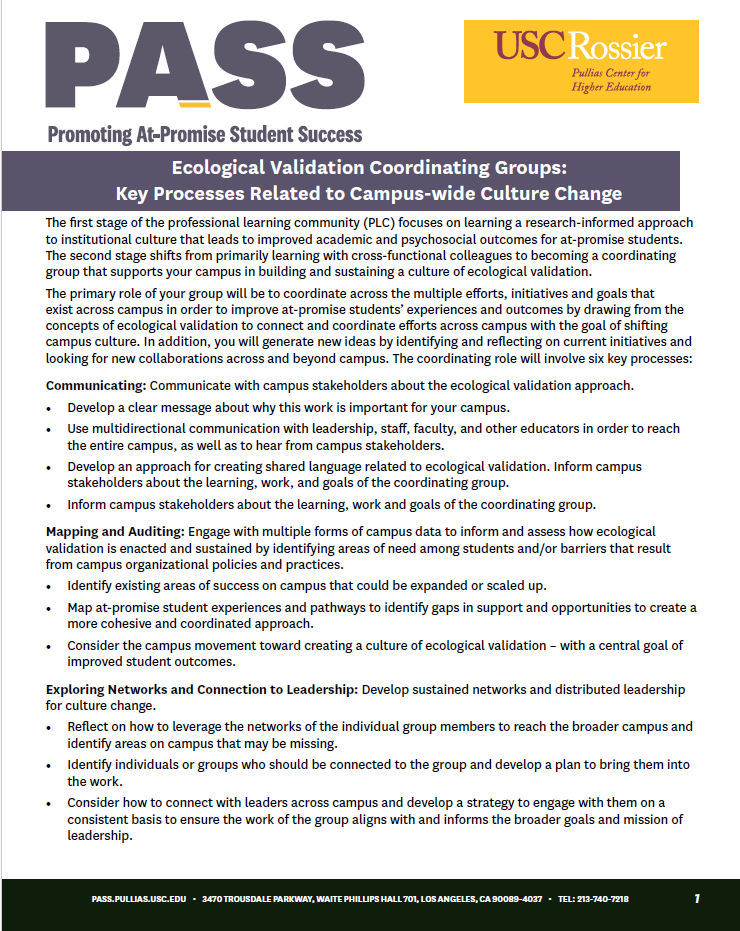
This brief outlines key processes for Ecological Validation (EV) Coordinating Groups to drive campus-wide cultural change that improves outcomes for at-promise students. It emphasizes strategies like mapping student experiences, developing professional development initiatives, and fostering sustainable leadership networks to embed EV principles across institutional practices.
Who is an educator on your campus?
This brief redefines the role of an educator on college campuses, emphasizing that all faculty, staff, and administrators contribute to student learning and success. It advocates for a student-centered approach to interactions, policies, and practices, promoting collaboration and systemic cultural change to address students’ multifaceted needs effectively.
Cross functional professional learning communities in higher education.
This brief provides an overview of how PLCs can be used in higher education. We discuss the origin of PLCs and compare them to other improvement processes in the higher education field. We then explain what a cross functional PLC is and why postsecondary institutions may benefit from using them. We end with some guiding questions to help campus stakeholders decide if this approach would be useful for your campus.
Exploring professionalism with at-promise college students.
Postsecondary educators play a critical role in helping at-promise students prepare for careers by providing resources that illuminate hidden workplace expectations around professionalism. This brief explores how professionalism programming can both reveal dominant workplace norms and affirm the assets students bring from their own communities.
Promoting at-promise college student success through peer mentoring.
Considering college students as “at-promise.”
This brief advocates for using a strengths-based “at-promise” approach to describe and support marginalized students in higher education, moving away from deficit-oriented “at-risk” terminology. It highlights the dual focus of recognizing students’ potential and institutional responsibility to remove barriers while fostering equitable and inclusive environments for success.
Moving toward institutional culture change in higher education: An exploration into cross-functional professional learning communities
This article explores the implementation of cross-functional professional learning communities (PLCs) involving faculty, staff and administrators at three different institutional types – research, urban regional, and rural regional universities – with the goal of learning about and then implementing a culture change approach to support academic and psychosocial success for historically marginalized student groups. The action research-based study explores the research question: Do cross-functional PLCs help support institution-wide culture change? And if so, how?